A constitutional amendment to carve K-12 public education out of California’s ban on race preferences cleared another committee last week, but not before one of the most charged exchanges of the session.
What ACA 7 Would Do
ACA 7, authored by Assemblymember Corey Jackson (D-Moreno Valley) and listed as a priority of the California Legislative Black Caucus, came before the Senate Committee on Elections and Constitutional Amendments. The bill would amend Section 31 of the California Constitution, the language voters adopted as Proposition 209 in 1996, to remove public education from its protection against race and sex preferences. Jackson framed it as a fix, saying the measure aims “to curtail the abuse and misuse resulting from its improper application and to ensure the constitutional provision aligns with the voters’ intentions in 1996.” Opponents call it what it is: a partial repeal of Prop 209.
A Republican Vice-Chair Takes the Gavel
Senator Scott Wiener chairs the committee, but he left to testify on another bill and handed the gavel to Vice-Chair Steve Choi, a Republican and himself a member of a minority community as a Korean American immigrant. Choi did not hide his concern. He pressed the author and witnesses again and again on a single question: why does California need race-based programs now that the state constitution and federal law already protect Black Americans and every other group from discrimination?
A Case for ACA 7
The author brought two supporting witnesses. Dr. Christopher Nellum of Ed Trust West argued that the status quo is not neutral. “Currently, the school system is producing outcomes that are pretty predictable on racial lines,” he said, adding that rigorous research shows “ability does not differ by race and ethnicity.” For Ed Trust West, he said, “ACA 7 is about following the data. The data will tell us where to focus, the data will tell us where to invest.” Education attorney Thuy Thi Nguyen argued that the bill clarifies what is already legal, pointing to a state appellate ruling: “As a California appellate court in American Civil Rights Foundation versus Berkeley Unified School District’s integration case stated, in its ruling for the school district, not all race conscious actions are meant to be eliminated by Prop 209.”
The Case Against ACA 7: A Partial Repeal of Prop 209
Two law professors testified in opposition. Maimon Schwarzschild of the University of San Diego rejected the idea that ACA 7 is a clarification. “Rather, excluding public education from its protection, it rips the heart out of prop 209,” he said. He warned that financial aid would become the real battleground, “because that’s the second most common place to find race discrimination in higher ed.” He tied the measure to the reparations task force, telling the committee, “Make no mistake about it. This will be a referendum on reparations, an exceptionally unjust version of reparations.”
His colleague, professor emerita Gail Heriot, predicted ACA 7 would lose at the polls as Proposition 16 did in 2020. “The previous effort to gut prop 209 went down in flames in 2020 with more than 57% of voters voting no,” she said. “And here’s the kicker, that’s despite the fact that the yes side outspent the no side by more than 14 to one.” She also warned of legal exposure, citing the U.S. Supreme Court’s Harvard decision: “eliminating race discrimination means eliminating all of it.” A defeated campaign, she argued, would leave supporters with “a couple of political and legal precedents not to their sponsors liking, and it’s a potential fiscal catastrophe.”
The Exchange Boils Over
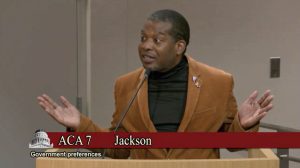
Then the temperature rose. Choi pressed his case that equal treatment regardless of race is the achievement of the civil rights movement, and that ACA 7 moves the state backward. Jackson responded with a personal account of harm done to Black and Native Americans, noting that his ancestors “are not immigrants. They were forced here.” When Choi invoked the constitution’s equal-treatment guarantee, Jackson cut him off: “And what we’re saying is we don’t care what the constitution says. What we’re saying is we live it every day, and the words have not fully been realized.”
The exchange grew personal. Choi suggested the darkest chapters of American history were behind us, saying “the dark age is over, thankfully.” Jackson shot back, “Says who this age is over? This is a bunch of black folks right here who are telling you, and you’re trying to tell us what’s over?” Moments later he told the chair, “what you’re doing right now is immoral. It is unjust, and I suggest that you just allow us to close.”
The Caucus Chair Steps In
That is when the hearing took an unusual turn. Senator Akilah Weber Pierson, chair of the California Legislative Black Caucus, came forward to speak. “I was not planning on coming up here today,” she said, “but I feel compelled to speak as chair of the California legislative black caucus.” She challenged anyone to find race-specific language in the bill: “I would like anyone to point out in the language where it specifically highlights black people. Show me in the language where it talks about giving preferential treatment to those of African descent. I will wait.” She argued the caucus fights for everyone: “as black individuals, we have always shouldered the burden for everyone else to ensure that America lives up to its dream and its promise. This is not just about black people.”
One Example, and It Helped Everyone
Weber Pierson also offered the hearing’s only concrete example of a race-conscious program, and it came from her own school days before Prop 209. She described a San Diego Unified initiative that “specifically focused on black male achievement in some of the schools that had the worst outcomes,” which created a position called “pupil advocates for schools.” But she immediately qualified it. The advocate at her school was assigned “specifically to work with black males, but not exclusively to work with black males,” she said, and over time “the achievement gap closed or narrowed and it improved the outcomes of everyone at that school.” Her conclusion made the opponents’ point for them: “Last time I checked, I’m not a black male, but I benefited and so many other people benefited from having him at that school. The entire school benefited and our entire scores went up.” She also pointed to a bill she once carried, AB 2774, which she said would have allowed “a different classification for the lowest performing subgroup based on race,” and which she said stalled “because of the concern of prop two zero nine.”
Jackson, by contrast, never described a program at all. Pressed by Choi to say what the next school year would look like if ACA 7 passed, the author declined to answer the question. “First, Mr. Chair, I really would like to close at this time,” he said. His co-author, Assemblymember LaShae Sharp-Collins, spoke only in terms of targeting dollars, arguing that “funds can be targeted to black student achievement” for better facilities, updated instructional materials, credentialed teachers, scholarships, and programming, but she named no specific practice that current law forbids.
It is worth noting that a sitting legislator from outside the committee stepping in mid-hearing to defend a contested bill is uncommon, and it underscored how much pressure the Black Caucus has placed behind this measure.
The Vote
Committee member Sabrina Cervantes eventually reclaimed her time, noting that “the two witnesses supporting prop two zero nine are not members of communities of color,” and voicing strong support. Senator Benjamin Allen called the bill “much more carefully crafted” than the 2020 effort and said it was unfair “to cast it in the same light.” The committee adopted the measure as amended and sent it to Appropriations on a motion by Cervantes.
The Question That Went Unanswered
For all the passion, the central question Choi asked went unanswered. The hearing’s one concrete example, Weber Pierson’s pupil-advocate program, served every student at the school by her own account, and the author would not say what ACA 7 would make possible that schools cannot already do. No one named a single educational practice that the amendment would newly allow and that race-neutral law forbids today.
CFC Vice President Greg Burt was direct. “Equal treatment under the law should not depend on the color of a person’s skin. California voters settled this question in 1996, and they settled it again in 2020. ACA 7 reopens the door to race-based preferences that divide our communities instead of uniting them. After hours of testimony, no one could name a single program this amendment makes possible that schools cannot already do today. That tells you everything you need to know.”
California voters have answered this question twice. ACA 7 asks them to answer it again.