There I stood, 250 years later, in Washington, D.C.
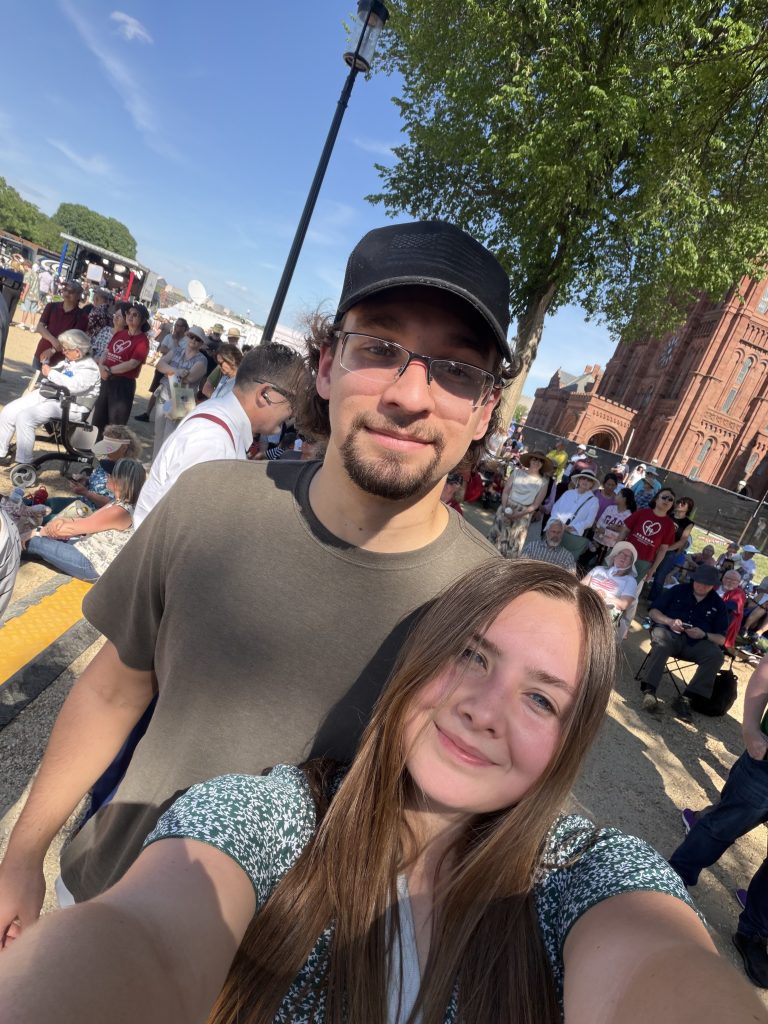
The capital George Washington himself chose. He surveyed this ground and knew what it would become. Soil where the British torched our Capitol in 1814, where Lincoln rallied a divided nation, where prayers have been lifted, and generations of Americans were buried after sacrificing for the survival of this republic. As I looked across the National Mall on May 17 during the Rededicate 250 gathering, I felt the weight of history in a way I never had before.
This was not just another political rally or patriotic celebration.
It was sacred.
Thousands of Americans from every corner of the nation stood together, openly worshiping in the heart of the nation’s capital. Families, veterans, pastors, students, and leaders lifted their hands toward heaven while songs about Jesus echoed between the Washington Monument and the Capitol dome.
For a moment, the noise of modern America seemed to fade.
And all I could think about was the long thread of history that brought us here.
Long before 1776, before there was a Constitution, before there was a Congress or a presidency, there were Pilgrims crossing the Atlantic believing they were being called by God to establish something new.
The Mayflower Compact declared that their voyage was undertaken:
“For the glory of God, and advancement of the Christian faith.”
Those words matter.
History before 1776 reveals the spiritual foundation underneath the American experiment. The Pilgrims and Puritans did not merely seek economic opportunity. They believed liberty and faith belonged together. John Winthrop envisioned America as a “city upon a hill,” accountable before God and observed by the world.
Standing in Washington 250 years later, I was encouraged that those ideas are still alive.
Sadie Roberts, granddaughter of the late Phil Robertson, opened the gathering with a question that cut to the bone. She reminded the crowd that in 2 Kings 22, the word of God had been physically lost in Israel until young King Josiah’s priests rediscovered it during a temple cleaning. Then she turned the question on America:
“Although the physical copy of the word has not been lost on us, I do wonder sometimes, has it been lost on us? Has the value of the word been lost on us? Has the awe and the wonder that we are one nation under God been lost on us?”
Roberts pointed to the simple starting place for national renewal: “Rededicate yourself to the Lord. Rededicate your family to the Lord. And in doing so, one person under God, one family under God, it will lead to a nation under God.”
That renewal is already beginning in small but meaningful ways. Across the country, ministries, churches, and grassroots movements are calling Americans back to Scripture. Events like America Reads the Bible, in which our president, Jonathan Keller, and outreach director, Sophia Lorey, participated; the National Day of Prayer event we hosted at the Capitol; and even this 250th rededication prove that we are fighting to return our nation to God.
Vice President JD Vance also spoke, reminding the crowd that America has always been sustained through prayer. He traced that spiritual inheritance from William Bradford’s prayer proclamations to the Continental Congress, from Abraham Lincoln’s calls for national fasting during the Civil War to the prayers offered on the National Mall that very day.
“We’ve always been and still are a nation of prayer, and thank God for that,” Vance declared.
He quoted John Adams: “Our Constitution was made only for moral and religious people. It is wholly inadequate to the government of any other.”
Then Vance issued a warning that landed hard: “It was obvious to the founders that our faith was the ground upon which America stands. Our very foundation as a people, and if it crumbles, so too will the values that make us Americans.”
Vance also pointed back to Charlie Kirk, whose memorial service many in the crowd had attended last fall. “As Charlie Kirk put it, all law reflects morality,” Vance said, drawing the line straight from Kirk’s life work to the day’s purpose. Morality does not appear in a vacuum. It comes from religion. And the religion that formed the American conscience was Christianity, founded upon the principles and divinity of Jesus Christ.
That truth feels especially relevant now.
It is common throughout history for nations to overthrow governments, rewrite constitutions, and radically change their systems of rule. Yet the United States has maintained the same constitutional framework since 1789. Two hundred thirty-seven years later, the Constitution of the United States remains the oldest written national constitution still in operation anywhere in the world.
No other constitutional system comes close to its longevity.
That continuity did not happen accidentally.
Speaker after speaker connected America’s endurance to faith, prayer, sacrifice, and providence. One speaker recounted George Washington crossing the Delaware River on Christmas night as exhausted Continental soldiers marched barefoot through snow and ice. At a moment when the American cause appeared completely lost, Washington still trusted in what he repeatedly called “Providence.” Another described Washington kneeling in prayer at Valley Forge as the army starved and froze during the winter of 1777.
As Memorial Day approaches, the meaning of sacrifice feels especially personal. Across Arlington and countless cemeteries nationwide lie generations of Americans who gave their lives believing this republic was worth defending. Their sacrifice was not merely for territory or political power, but for the preservation of a nation rooted in liberty, responsibility, and faith.
Major General Patrick Brady called veterans “America’s nobility” and declared, “There is no America without faith.”
South Carolina Senator Tim Scott reminded the crowd that the Civil Rights Movement succeeded not merely because of politics, but because churches prayed before they marched. “Bombed churches did not silence the worship,” Scott said. “It amplified the worship.”
Dr. Ben Carson, former U.S. Secretary of Housing and Urban Development, drew the line plainly drew the line plainly: “250 years ago, America was born in a declaration of independence that began with the revolutionary acknowledgment that our rights come from God and not from government, and it ended with an appeal to divine providence for protection.”
He pushed back on the idea that America’s greatness was a matter of systems or policies: “It wasn’t our policies, and it wasn’t our systems that made America great. It was our people, giving humble hearts to God and helping hands to each other.”
That same spirit was visible earlier this month during the California Family Council’s National Day of Prayer observance, where believers gathered to pray publicly for California, its leaders, families, churches, and future generations. In a state often portrayed as hostile to faith, the gathering served as a reminder that many Christians remain committed to seeking God’s guidance for both church and state.
Speaker of the House Mike Johnson prayed a prayer of protection over those who risk their lives daily.
“Give us the wisdom and humility to serve selflessly and sacrificially. Lord, protect our service members, our law enforcement officers, our first responders, all those who risk their own lives daily as they administer justice and preserve the peace in our communities and in accordance with your word.”
Johnson traced the unbroken thread from the very first European arrivals to the National Mall on May 17th. “We remember that your mighty hand has been upon our nation since the very beginning. Since Christopher Columbus set sail in the New World. Since the settlers at Jamestown planted the cross at Cape Henry, and since the Pilgrims at Plymouth made a covenant to give you the glory.”
He grounded America’s founding directly in Scripture. “You gave our fathers the wisdom and faith to establish this new nation premised on the biblical and foundational principle that all men are created equal and free before you. Through your divine providence, our founders acknowledged and boldly proclaimed the self-evident truth that every single person is created in your image.”
He did not flinch from naming what America is up against. “These voices insist to the young and impressionable that our story, the American story, is one of oppression and hypocrisy and failure, and that this story can only be understood through the lens of our sins. But Father, we reject that. We rebuke it in your name.”
Then Johnson spoke the words the day had been building toward: “Today, here Lord, in this 250th year of American independence, we hereby rededicate the United States of America as one nation under God.”
As I listened, I realized Rededicate 250 was about far more than nostalgia. It was not simply about honoring the past. It was about asking whether America still remembers who she is.
The event’s Jubilee theme carried enormous significance. In Scripture, every 50 years marked a national reset, a time of restoration, repentance, freedom, and return to God’s order.
And perhaps that is exactly what many Americans feel our nation desperately needs now: not merely political reform, not merely economic recovery, but spiritual renewal.
Because history shows that nations do not survive forever simply because they are wealthy or militarily powerful. Empires collapse. Constitutions fail. Cultures decay from within.
Yet somehow America has endured through revolution, civil war, world wars, depression, terrorism, and national division.
Standing among thousands praying over this nation, I felt both gratitude and responsibility. We inherited something precious. The question now is whether our generation has the courage, humility, and faith to preserve it for the next 250 years.
As America approaches both Memorial Day and its 250th anniversary, the question before us is no longer merely political. It is civilizational. Will we remember the principles, sacrifices, and faith that gave birth to this nation, or will we allow them to fade into history?
Standing on the National Mall among thousands of believers praying over America, I was reminded that renewal begins the same way it always has: with repentance, courage, gratitude, and dependence upon God.
The next 250 years will be shaped by whether America still remembers that truth.