A bill designed to keep convicted sex offenders out of public office cleared the Assembly floor 67 to 0. Then it went through the Senate Elections Committee, chaired by Senator Scott Wiener (D-San Francisco), and came out with a hole in it big enough for child predators to walk through.
AB 2691, authored by Assemblywoman Dawn Addis, is called the Public Trust Protection Act. It would disqualify people convicted of felony sexual assault or human trafficking from running for or holding state or local elected office. California Family Council supports that idea. The problem is what got added on June 24.
What the Amendment Does
The bill defines “sexual assault” to include crimes like rape, sodomy, oral copulation, and sexual penetration. But a new exception carves out three of those crimes when they are committed against a minor: felony sodomy, oral copulation, and sexual penetration of a child, including cases where the perpetrator is over 21, and the victim is under 16. Committed against an adult, those crimes count as sexual assault and bar someone from office. Committed against a child, they don’t.
In plain terms: a person convicted of felony sexual assault against an adult would be barred from public office under this bill. A person convicted of the same act against a child would not be.
What Greg Burt Told the Committee
California Family Council Vice President Greg Burt testified against the bill, telling the committee CFC’s first reaction to the amendment was disbelief.
“We sat in our office and tried to imagine how anyone could stand up and defend it,” Burt said. “So I am here today, genuinely hoping someone will finally tell us why crimes against children are being carved out of this bill.”
Burt was direct about where CFC stands: “Barring people convicted of felony sexual assault and human trafficking from holding public office is good policy. We want to support this bill.” But he laid out the amendment’s effect in stark terms: “A person convicted of felony sexual assault against an adult would be barred from public office. A person convicted of those same acts against a minor would not be. Adult victim, you’re disqualified. Child victim, you may run for school board.”
Burt told the committee CFC was informed the amendment came at the insistence of the committee chair, Sen. Wiener. He noted the exemption has no stated justification: “No one has offered a rationale. The committee’s own analysis does not offer one.” He pointed to Utah as a contrast, saying that state permanently bars anyone convicted of grievous sexual assault against a child from serving on a school board. “This amendment moves California in the opposite direction,” Burt said. “It protects child victims least, exactly where protection matters most.”
CFC’s position, as Burt stated it: “We are ready to become strong supporters the moment these three exemptions are removed. Until then, we urge a no vote.”
Lorem ipsum dolor sit amet, consectetur adipiscing elit. Ut elit tellus, luctus nec ullamcorper mattis, pulvinar dapibus leo.
Senator Choi’s Objection
Sen. Steven Choi pressed the author on the exemption directly, asking why “someone who engaged in sexual acts with minors should be able to run for local or state office, for that matter, national office.”
When Addis did not answer the substance of the carve-out, Choi laid out the specific penal code sections being exempted, sodomy of a minor, oral copulation of a minor, and sexual penetration of a minor, and said the exclusion could not be reconciled with the bill’s stated purpose.
Choi closed his remarks with this: “I now believe that this bill must be opposed because of the absurd message that it sends, namely that it’s okay to have pedophiles and child groomers in elected office. Until heinous crimes involving minors are restored in the definition of a sexual assault under this bill, I would not be able to, in good conscience, support this bill.”
The Chair’s Response
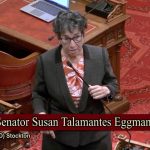
Sen. Wiener defended the bill and criticized the opposition, calling it “a new world record in political cynicism.” He argued that no felonies were removed from the bill by the amendments, and that CFC and allied opponents have never previously proposed legislation to bar anyone from office for any crime. He called the opposition’s objection political rather than substantive and voiced his support for the bill as amended.
That claim does not hold up against the text of the exemption itself. All three penal code sections carved out of the bill’s definition of “sexual assault” contain an explicit felony provision: any person over 21 who commits the act against a victim under 16 “shall be guilty of a felony,” no exceptions, no wobbler. Wiener’s office later told reporters the amendment was meant to protect young adults who had recently been minors themselves, citing the example of an 18-year-old with a 17-year-old partner, a case typically charged as a misdemeanor. But the exemption as written does not stop there. It also excludes the felony committed by an adult over 21 against a child under 16, a fact pattern with a five-year-or-greater age gap that state law treats as a straight felony, not a wobbler and not a close-in-age exception. If the goal was to fix the narrower problem Wiener described, the exemption could have been written to exclude only the misdemeanor provisions and leave the felony provisions in place. It was not written that way.
Wiener did not address, on the record, why sodomy, oral copulation, or sexual penetration against a minor should be treated differently than the same acts against an adult for purposes of holding office.
Where the Bill Stands
The committee reconvened after the quorum issue was resolved and voted 4 to 1 to advance AB 2691 out of the Senate Elections and Constitutional Amendments Committee on June 30, with the child-exemption language in subdivision (3)(B) intact.
Voting yes: Sen. Ben Allen (D-Santa Monica), Sen. Sabrina Cervantes (D-Riverside), Sen. Tom Umberg (D-Santa Ana), and Committee Chair Sen. Scott Wiener (D-San Francisco).
Voting no: Sen. Steven Choi (R-Irvine).
The bill now moves forward with sodomy, oral copulation, and sexual penetration of a minor still excluded from the definition of “sexual assault” that triggers disqualification from office.
The same committee killed a separate, broader bill in the same hearing, just before taking up AB 2691. AB 2753, authored by Assemblywoman Esmeralda Soria (D-Merced), would have barred anyone required to register as a sex offender under California law from running for or holding state or local office, covering all three registry tiers. Soria introduced the bill after Rene Campos, a registered sex offender convicted of possessing child sexual abuse material, announced a run for Fresno City Council. The bill had passed the Assembly with bipartisan support.
Soria had already agreed to limit the bill to people on the sex offender registry, rather than a broader felony-based standard. The sticking point was which tiers counted. Wiener and other committee members wanted the bill narrowed further, to Tier 3 only, the state’s lifetime registration tier reserved for the most serious offenders, and pushed to drop Tier 1 and Tier 2 registrants from the ban. Soria refused, insisting the bill needed to cover all three tiers to actually protect her community. She said she had promised her community a real fix and that narrowing it further would have gutted it: “The bottom line is this: I was not willing to make additional amendments to this bill. I made a promise to my community that I would do everything in my power to ensure they would never have to go through something like this again. Accepting additional amendments to this bill would have jeopardized that promise.”
With neither side willing to move, the committee vote ended in a tie, and AB 2753 died. Wiener voted no. Minutes later, the same committee took up AB 2691, and this time Wiener’s preferred approach, a narrower bill with the child-crime exemption built in, is the one that advanced.
California Family Council’s position has not changed. This bill should protect every victim, not carve out an exception for the youngest and most vulnerable. The fix is simple: remove the exemption in subdivision (3)(B) and restore the bill to the form that passed the Assembly unanimously, 67 to 0.
Testimony Goes Viral
Greg Burt’s testimony before the committee has struck a nerve online. The video, posted to Instagram, drew 126,000 views in the first day alone. See below…