Governor Gavin Newsom stood flanked by Planned Parenthood executives and Democratic legislative leaders this week as he proudly signed SB 106 into law, directing $90 million in “emergency funding” to the abortion provider. The bill was fast-tracked through the Legislature after federal funding changes under the Trump administration, and the signing ceremony was anything but subdued.
The Governor’s official press page prominently featured the event, showcasing applause, smiling lawmakers, and Planned Parenthood representatives celebrating the windfall. Newsom framed the legislation as California’s bold stand for “reproductive freedom,” reinforcing the state’s role as a national sanctuary for abortion access.
But beyond the celebratory optics lies a deeper question: Why does a politically powerful private nonprofit receive immediate, no-strings-attached taxpayer funding, while other healthcare providers across California are forced to beg for loans, navigate red tape, or close their doors?
A Politically Active “Nonprofit”
Planned Parenthood is not merely the state’s biggest abortion provider. It is one of the most politically active organizations in California, with a powerful lobbying arm, a legislative scorecard grading lawmakers, and a long history of campaign contributions to state officials.
According to figures readily available at (CalMatters Digital Democracy website) Planned Parenthood has given California Legislators and Governor Gavin Newsom a total of $1,593,565 over the last decade.
Maybe that explains why lawmakers moved $90 million to the organization in a matter of days, without a traditional committee hearing process and without restrictions preventing the funds from indirectly supporting political activity.
Debate on the Assembly Floor
That tension became clear during Monday’s Assembly floor debate.
Republican lawmakers offered amendments to ensure the funding could not be used for lobbying or political operations. They questioned the urgency, the lack of procedural transparency, and the optics of awarding millions to a politically connected organization while rural hospitals face bankruptcy and maternity wards close throughout the state.
At a time when low Medi-Cal reimbursement rates and expensive state mandates are pushing community hospitals to the brink, critics argued that Sacramento appears to have chosen a clear favorite.
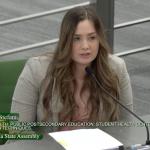
When the bill was presented on the Assembly floor, Assemblyman David Tangipa (R-Fresno) explained the Republican amendments as a simple safeguard to ensure the money could be used for “distressed rural hospitals” and not used for lobbying or political activity. The Democrats quickly rejected those amendments and then passed SB 106 with a vote of 55-14 after a long debate.
Most legislators defended the funding without hesitation. Assemblywoman Mia Bonta (D-Oakland) called Planned Parenthood “a literal lifeline.”
Assemblyman Mike Gipson (D-Gardena) said he ran for office “to stand up for those who can’t stand up for themselves,” arguing that directing $90 million to Planned Parenthood fulfilled that mission.
Process, Priority, and Political Influence
But others questioned both the process and the priority.
Assemblywoman Natasha Johnson (R-Corona) criticized the bill for moving forward without a public hearing, stating, “We have not had one single public hearing, yet we are being asked to approve $90 million in taxpayer funds.”
Assemblyman Carl DeMaio (R-San Diego) argued that the Legislature had not backfilled other federal reductions in healthcare funding and questioned whether the grant appeared to reward a politically connected organization.
Those concerns raise a broader question: How much political influence does Planned Parenthood wield at the state Capitol?
According to Digital Democracy, SB 106’s author, Assemblyman Jesse Gabriel (D-Encino), received $17,547 in contributions from Planned Parenthood-affiliated entities between 2015 and 2025. Here is a list of state politicians who have received contributions from Planned Parenthood over the past 10 years.
- Governor Gavin Newsom $68,500.00
- Senator Sabrina Cervantes (D-Riverside) $144,945.00
- Former Assemblywoman and current Congresswoman Laura Friedman (D-Burbank) $90,937.00
- Senator Eloise Gómez Reyes (D-San Bernardino) $63,454.00
- Assemblyman Al Muratsuchi (D-Torrance) $58,088.00
- Assemblywoman Sharon Quirk-Silva (D-La Palma) $54,432.00
- Former Senator Anthony Portantino (D-Burbank) $53,258.00
- Former Assembly Speaker Anthony Rendon (D-Southgate) $48,816.00
- Senator Henry Stern (D-Sherman Oaks) $39,250.00
- Assemblywoman Cottie Petrie-Norris (D-Irvine) $37,685.00
- Insurance Commissioner and former Senator Ricardo Lara (D-Bell Gardens) $37,290.00
- State Superintendent of Public Instruction and former Assemblyman Tony Thurmond (D-Richmond) $26,820.00
- Assemblyman James Ramos (D-San Bernardino) $23,278.00
- Assemblyman Mike Gipson (D-Gardena) $14,586.00
(Go here for a complete list of California state politicians who have received contributions from Planned Parenthood since 2015.)
Lobbying, Scorecards, and Legislative Leverage
Planned Parenthood Action Fund also publishes a legislative scorecard grading lawmakers based on their voting records related to abortion and reproductive policy, reinforcing the organization’s political engagement.
Additionally, Assemblyman Tangipa questioned why hospitals must request emergency loans while Planned Parenthood received a direct $90 million grant.
“Between the low Medi-Cal reimbursement rates and the high cost of required seismic renovations, many hospitals are struggling just to keep services available. These are comprehensive Medi-Cal services that nonprofits simply can’t and don’t provide. In Madera County right now, women must travel outside their county just to give birth, despite a nonprofit operating an office there,” Tangipa said.
His remarks suggested that if lawmakers truly want to preserve women’s healthcare access, stabilizing local maternity wards and emergency departments should be a higher priority.
Personal Testimony and Political Justification
Some of the support for Planned Parenthood appeared rooted in personal experience.
“We’re able to stand up here today and say that this is a good investment because many of us have been patients,” Assemblyman Gabriel said.
Assemblywoman Buffy Wicks (D-Oakland) shared her own Planned Parenthood story, saying that the clinic’s abortion of her unborn child enabled her to pursue political opportunities she believes she would not have had otherwise.
“I made a choice to have an abortion. And then that led me to live this life where I got to go work for the first Black President of the United States of America, President Barack Obama. I got to meet my now-husband. I got to have my two beautiful babies when I was ready to have them,” she said.
“And I got to create that life because Planned Parenthood gave me that opportunity to make that choice and to make that decision at that vulnerable time of my life.”
The Numbers Behind the Narrative
During the hearing, it was stated multiple times that Planned Parenthood provides more than just abortion services, such as breast exams, STI testing, Pap tests, pregnancy tests, and birth control.
However, when you break down the numbers, abortion remains the number one service at Planned Parenthood. According to Live Action, Planned Parenthood does 0.97% of America’s pap tests, 1.8% of breast exams, and 34.9% of America’s abortions. According to Planned Parenthood’s 2023-2024 report, it performed 402,200 abortions. Dividing that number by the total number of patients shows that approximately one in five visits resulted in an abortion.
Assemblyman Gabriel argued, “Doesn’t seem very pro-life to me to take away 100,000 cancer screenings.”
- FreeClinics.com states that there are 1,488 health clinics in the state of California that offer free or low-cost services. According to the California Alliance of Pregnancy Centers, there are 168 life-affirming pregnancy help centers in California that provide the following free services for women.
Medical services provided by licensed clinics may include:
- Urine pregnancy testing
- Ultrasound examinations
- Medical referrals
- Prenatal vitamins
- STI/STD testing and treatment
- Early prenatal care
Non-medical Resource center services may include:
- Parent education and resources
- Reproductive grief support
- Peer counseling and education; all options discussed
- Maternity clothing
- Baby supplies (diapers, baby wipes, formula, clothing, blankets, and more)
- Support groups
- Healthy family support
- Emotional support
- Information on natural family planning
A Question of Fairness and Public Trust
Taken together, these numbers suggest that women’s healthcare access extends far beyond a single organization.
However, these organizations don’t receive the same legislative support in California as Planned Parenthood. This effectively picks one winner while limiting women’s choices. True healthcare access comes from a diverse network of providers, not a government-backed monopoly.
“If the state legislature wants to provide a safety net for women and families, they should support smaller clinics, community health centers, and pregnancy resource centers rather than politically corrupt organizations that use taxpayer dollars to murder the unborn and legally bribe legislators for more financial support,” said CFC Vice President Greg Burt.