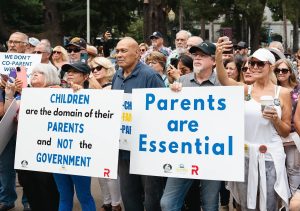
The U.S. Supreme Court is now considering First Choice Women’s Resource Centers v. Platkin, a case that could dramatically strengthen constitutional protections for pro-life pregnancy centers nationwide. California Family Council (CFC) and our allies have warned for years that abortion-friendly officials may weaponize regulatory tools to intimidate ministries offering life-affirming help to women. This case finally forces the Court to confront that threat.
In 2023, New Jersey Attorney General Matthew Platkin launched an investigation into First Choice Women’s Resource Centers, despite no specific client complaints. His office issued a sweeping subpoena demanding years of internal communications, staffing information, and even the names, addresses, and employers of the center’s donors and volunteers.
First Choice responded by filing a federal civil-rights lawsuit, arguing that the subpoena amounted to political retaliation. As Alliance Defending Freedom (ADF) noted in its case summary, the government has no business demanding lists of donors and volunteers as punishment for a ministry’s pro-life viewpoint.
What’s At Stake: Vulnerable Moms and Babies
The legal question is straightforward: Are faith-based ministries allowed to seek federal court protection from an abusive state investigation before irreparable harm occurs? If not, states could drag politically disfavored nonprofits through expensive legal battles designed to drain resources and chill support.
At the December 2 oral argument, several justices expressed concern over the state’s tactics. According to the New York Post, Justice Clarence Thomas pressed New Jersey’s attorney to admit the investigation specifically targeted a pro-life charity, calling the state’s tactics a “fishing expedition.”
Chief Justice John Roberts highlighted the potential “chilling effect” on charitable giving, while Justice Neil Gorsuch questioned why donor privacy was so easily dismissed by the state. As CNN reported, Chief Justice Roberts asked New Jersey’s attorney point blank: “Do you think that they have a credible chill concern?” When the pro-abortion counsel said no, Justice Roberts followed up: “So you don’t think it might have an effect on future, potential donors to the organization to know that their name, phone number, address, etcetera could be disclosed as the result of the subpoena?”
Faith-based outlets also noted the significance of the case. Catholic News Agency observed that the justices “appeared sympathetic” to concerns about government overreach against faith-based charities:
The National Catholic Register further noted that Justice Amy Coney Barrett “flagged that New Jersey has specifically targeted pregnancy centers — a pattern reminiscent of California’s now-defunct FACT Act.” NCR also reported that Chief Justice Roberts referenced a different legal slap-down against California, Americans for Prosperity Foundation v. Bonta. In that case, yet another defeat for Golden State hubris, SCOTUS “invalidated California’s donor-disclosure rule as a violation of associational freedom.” Roberts wrote that Sacramento legislators used an indiscriminate “dragnet for sensitive donor information”, and ADF now argues on behalf of First Choice that the subpoenas from New Jersey double down on California’s errors while heaping additional violations on top.
Liberty Counsel reported that during oral arguments, Justice Kavanaugh quoted an amicus brief from the ACLU: “a speaker is not obligated to wait for formal enforcement before challenging the constitutionality of state action” and “a subpoena seeking sensitive donor information can chill a disfavored speaker’s protective associations long before it’s ever enforced.”
Why This Matters for California
California has long been a national testing ground for efforts to marginalize pro-life pregnancy resource centers, or PRCs. Abortion activists and state agencies frequently brand these ministries as “fake clinics,” seeking to regulate or penalize them.
Starting in 2015, CFC helped lead the fight against AB 775, the so-called “Reproductive FACT Act.” This horrible bill forced PRCs to advertise state-funded abortion services on their own premises. Governor Jerry Brown signed the law at the urging of Planned Parenthood and NARAL. CFC documented the bill’s coercive impact here:
In 2018, the U.S. Supreme Court struck down AB 775 in NIFLA v. Becerra, declaring that California’s mandate “targets speakers, not speech,” and therefore violates the First Amendment. But even after AB 775 fell, new forms of pressure emerged. State agencies have issued “consumer alerts,” conducted surprise inspections, and collaborated with abortion interest groups to stigmatize pregnancy centers.
The First Choice case addresses whether governments may achieve through subpoenas and investigations what NIFLA forbade them from doing through compelled speech.
The Historic Foundation: NAACP v. Alabama
The constitutional principles at stake in First Choice rest on bedrock civil rights precedent. In 1958, the U.S. Supreme Court unanimously ruled in NAACP v. Alabama ex rel. Patterson that Alabama could not force the National Association for the Advancement of Colored People to disclose its membership lists to state authorities who were intent on harassing civil rights advocates.
Justice John Marshall Harlan II, writing for a unanimous Court, declared: “This Court has recognized the vital relationship between freedom to associate and privacy in one’s associations… Compelled disclosure of membership in an organization engaged in advocacy of particular beliefs is of the same order [as other forms of governmental restraint].” The Court continued: “Inviolability of privacy in group association may in many circumstances be indispensable to preservation of freedom of association, particularly where a group espouses dissident beliefs.”
The Court recognized that forced exposure of supporters would “induce members to withdraw from the Association and dissuade others from joining it because of fear of exposure of their beliefs,” which is the same “chilling effect” pregnancy centers now face. As the Encyclopedia of Alabama notes, the Court understood that NAACP members faced real threats of “economic reprisal, loss of employment, threat of physical coercion, and other manifestations of public hostility.”
The Institute for Free Speech explains the enduring relevance: “Thanks to the Court’s ruling, nonprofits and other civic organizations have flourished in America with the knowledge that the private information of their supporters will be protected.” Yet “people with controversial views still face threats identified in the Court’s ruling,” including “‘economic reprisal, loss of employment, threat of physical coercion, and other manifestations of public hostility.'”
First Choice represents the direct application of these civil rights protections to pro-life ministries facing similar governmental harassment today.
Pregnancy Centers: An Unmatched Record of Service
While abortion advocates seek to undermine pregnancy centers through litigation and intimidation, these ministries continue to demonstrate extraordinary compassion and effectiveness. The Charlotte Lozier Institute’s 2025 National Pregnancy Center Report reveals that in 2024 alone, America’s 2,775 pregnancy centers provided over $452 million in total medical care, support services, education, and material goods to women and families.
The scope of this service is staggering. Pregnancy centers served over 1 million new clients in 2024, with nearly 4 million total client sessions. That’s equivalent to each center serving a new client every single day. Material support increased 48% from 2022 to 2024, including 6,353,386 packs of diapers, 1,604,996 packs of wipes, 4,980,839 baby outfits, and 373,531 cans of formula.
Medical services have expanded dramatically. Eight in ten centers now provide free or low-cost medical services, staffed by over 10,000 medical professionals. In 2024, 81% of centers offered ultrasounds, performing 636,514 of them. That represents a 60% increase from 2017 to 2024. Client satisfaction reached 98%, up from 97.4% in 2022.
Dr. Sandy Christiansen, national medical director at Care Net, emphasized the life-saving impact: “From 2017 to 2024, there was a 60% increase in the number of ultrasound exams—each one affecting three lives: babies spared from death, and women and men protected from the heartache and risks associated with abortion.”
Karen Czarnecki, executive director of the Charlotte Lozier Institute, told The Center Square that pregnancy centers “are providing medical care, support and education services, and material goods not only for pregnant women in need, but also their families.” Too often, “pregnant women lack support, affordable health care, prenatal education, or basic materials,” said Czarnecki. “But pregnancy centers are there to serve them with minimal (or no) cost and no judgment.”
This stands in stark contrast to Planned Parenthood, whose services have declined dramatically. According to Charlotte Lozier Institute’s analysis of Planned Parenthood’s own annual reports, since 2013 the abortion giant has seen total services drop more than 10%, cancer screening decline 54%, prenatal services plummet 63%, and patient visits fall 23%.
How First Choice Could Shape the Fight for Life
A strong ruling in favor of the pro-life pregnancy centers in this case could have a massive impact across the nation, including here in California! Depending on the breadth of the ruling, a favorable outcome would:
1. Protect Pregnancy Centers Before Harm Occurs
It would ensure ministries have access to federal courts before they are forced to turn over donor lists, internal files, or private counseling materials. “The Constitution protects First Choice and its donors from demands by a hostile state official to disclose donor identities and contact information, and First Choice is entitled to vindicate those rights in federal court,” said ADF Senior Counsel Erin Hawley, vice president of the ADF Center for Life and Regulatory Practice.
2. Safeguard Donor Privacy
Donors to pro-life organizations have increasingly faced harassment, doxing, and employment threats. The Supreme Court reaffirmed the importance of donor anonymity in 2021 (Americans for Prosperity Foundation v. Bonta), with Chief Justice John Roberts writing that California cast “a dragnet for sensitive donor information” without demonstrating narrow tailoring. A ruling for First Choice would extend that protection to PRCs facing hostile investigations.
3. Strengthen CFC’s Fight Against Anti-Life Hostility in California
CFC has spent years countering aggressive state policies designed to shame or silence pro-life ministries. This ruling could decisively limit officials’ ability to target centers through administrative harassment rather than overt speech mandates. As CFC President Jonathan Keller has said, “Pregnancy centers are not the problem. They are the solution. They embody the love of Christ, offering real help to women and families that abortion clinics never will.”
4. Reassure Churches and Volunteers
Hundreds of California churches partner with PRCs. Volunteers (many of them retirees, pastors, and young adults) should never fear that their names could be demanded by political actors simply because they serve women in crisis pregnancies. As New York Families Foundation observed in discussing similar harassment by New York Attorney General Letitia James, such investigations create a “legal bind: comply and potentially violate principles and donor privacy, or resist and risk penalties.”
5. Strengthen the National Pro-Life Infrastructure
Former U.S. Senator Rick Santorum (R-PA) recently emphasized the importance of this case in National Review, arguing that pro-life organizations are increasingly targeted not due to misconduct but because of their beliefs. He highlights a pattern of political pressure and regulatory scrutiny directed at life-affirming pregnancy centers.
Christian Broadcasting Network recently featured PRCs as providing essential services, while noting the coordinated campaign of harassment from Democratic officials. “The government can’t harass those who support pro-life ministries just because it disagrees with their message and their mission,” First Choice Executive Director Aimee Huber told CBN.
If the Court reinforces these protections, pregnancy centers nationwide will be better equipped to serve women with courage, clarity, and compassion, continuing their proven track record of providing life-affirming alternatives that respect both mother and child.