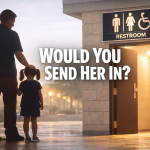
California is quietly moving toward mixed-sex bathrooms in K-12 schools, and the state’s own Department of Education is leading the way.
A new law California Family Council opposed, SB 760, now requires schools to provide at least one “all-gender” restroom option on campus. The stated goal was to make transgender-identified students feel safer from bullying. But in the rush to accommodate those students’ feelings, lawmakers apparently gave little thought to a different safety question: what happens when boys are given access to girls’ bathrooms and locker rooms?
The State Is Already Building the Roadmap
The California Department of Education has an entire webpage dedicated to “All Access Restrooms,” describing it as a resource offering background information, planning and design resources, laws and regulations, and references for implementing “gender-inclusive” restrooms in K-12 schools.
The background information on that page acknowledges that “the designs of all-access restrooms have been trending in schools throughout the state, the country, and the world,” while noting there are currently no California design standards for these facilities. In other words, the trend is already underway, and the standards are still catching up.
The planning section of the CDE page is even more candid about the scope of what is being proposed. It describes “shifting from multi-user gendered restrooms and single-user all-gender restrooms to offering blocks of restroom facilities for all students;” meaning the goal is not just a single converted nurse’s bathroom tucked in a hallway. The ambition is to redesign entire blocks of school restroom facilities so that boys and girls share the same space.
What Would It Look Like?
The new all-gender bathroom designs typically eliminate urinals entirely, replacing them with individual private stalls accessible to everyone. The CDE’s resources page recommends an academic article published in the Education Sciences Journal titled “Expanding the Scope of Universal Design: Implications for Gender Identity and Sexual Orientation,” by Ellyn Couillard and Jeanne L. Higbee (2018), as a guide for implementation. That an academic paper on gender identity ideology is among the state’s recommended planning resources tells you something about the ideological framework driving these design decisions.
But keep in mind, SB 760 doesn’t require a complete redesign of a single-sex bathroom for it to become all-gender.
You Already Saw It at the State Capitol
If you want to get a glimpse of what legislators have in mind when they convert a single sex bathroom into an all gender bathroom, take a look at one of the converted male bathrooms at the state capitol, used by legislative staffers, adult visitors, and elementary school children visiting on field trips. California Family Council Vice President Greg Burt recently took a video of the empty bathroom located to one side of the Capitol Dome. “I’m pretty sure most parents would object to their young children sharing a bathroom while men are using the urinals,” Burt said. “Even without the adult issue, I’ve witnessed the chaos that occurs when young boys are pouring into the same bathrooms as the girls while visiting the Capitol. The girls are not happy about it.”
So what should parents expect when multi-stall bathrooms are converted to all gender at their child’s school?
What the Law Actually Requires — And What It Doesn’t
It is important to be clear about what SB 760 does and does not mandate. The law requires that every school campus have at least one all-gender restroom option available to students. It could be single-stall or multi-stall. It must be supplied with menstrual products starting in 3rd grade, and it must be unlocked and easily accessible. But there are no requirements that urinals be removed or that additional privacy measures be added to stalls.
Sex-separated restrooms are still permitted, and most schools will continue to have them.
Burt explained what this means in practice for families. “How each school fulfills this new requirement is entirely up to the local school board. A conservative district might simply relabel a single-occupancy nurse’s bathroom and call it done. A progressive district could use this law as a green light to convert entire multi-stall restroom facilities to mixed-sex use. Parents need to find out right now what their district is planning,” he said.
The CDE’s planning resources make clear that the broader vision goes well beyond a single-stall accommodation in the corner of the building. It points toward a wholesale redesign of school bathroom facilities, one that treats sex-separated restrooms as a problem to be solved rather than a common-sense protection for children.
The Question Nobody in Sacramento Answered
SB 760’s supporters argued the law was needed to protect transgender-identified students from harassment, but the legislature never seriously asked the parallel question: does giving boys access to girls’ bathrooms and locker rooms create new opportunities for harassment and assault of girls?
California has seen case after case in recent years where policies designed to accommodate gender identity have created unsafe situations for female students. The discomfort of girls sharing intimate spaces with biological males is not a lesser concern. Lawmakers who refused to weigh it have not protected children. They have simply chosen which children’s safety matters.
Parents: Now Is the Time to Speak Up
Because each school board will decide how to implement SB 760 on its own campuses, parents have a real opportunity to influence what happens at their child’s school, but that window will not stay open indefinitely. Decisions about restroom redesigns and facility changes get made early in the budget and planning process, often before most parents are even aware the conversation is happening.
If you want a say in how your district handles this new requirement, call your school board member and school administrators now. Ask them directly: how does our district plan to fulfill the SB 760 all-gender restroom requirement? Will existing sex-separated restrooms be preserved? Will multi-stall facilities be converted? Every parent deserves to know the answers.
Here is one of the committee hearings from 2023, when SB 760 was discussed, and CFC provided opposition testimony.