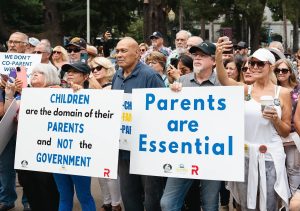
In a critical win for parental rights and religious freedom, the U.S. District Court for the Southern District of California has ruled that the Encinitas Union School District (EUSD) must provide advance notice and opt-out rights for parents when controversial gender identity ideology is presented to students within the school’s mentoring program. This overturns a policy followed by the majority of California public schools, which prohibits parents from opting their children out of gender identity lessons. It’s a great legal victory for the National Center for Law and Policy, and First Liberty Institute, which offers pro-bono services to protect the Constitutional rights of Californians.
The court’s preliminary injunction, issued in S.E. v. Grey, prohibits EUSD from continuing to indoctrinate students in gender identity ideology in their “buddy” program without parental knowledge and consent. The decision came after fifth-grade students were compelled to teach kindergarteners about gender fluidity using the book “My Shadow is Pink.”
“This decision affirms what every Christian parent in California already knows in their heart: God gave children to parents, not to the state,” said Greg Burt, Vice President of the California Family Council. “School officials have no right to coerce students into becoming mouthpieces against biological realities and for gender ideologies that undermine biblical truth.”
A Forced Lesson in Gender Identity
The incident began in May 2024 when a fifth-grade teacher at La Costa Heights Elementary School read aloud My Shadow is Pink—a book that teaches children to reject their objective biological sex and embrace subjective gender identities. Fifth-grade students were then asked to guide their kindergarten “buddies” in expressing and illustrating their “inner” gender by chalking their outline in the color of their gender without any prior parental notification.
The participating families, including devout Christians Carlos and Jennifer Encinas, learned about the exercise only after the fact. They promptly requested future notice and opt-out opportunities for any instruction related to gender ideology. Their request was denied.
The court found that forcing children to participate in lessons that conflict with their family’s deeply held religious beliefs—especially without any parental consent—violated the Free Speech and Free Exercise Clauses of the First Amendment.
“No child should be forced to speak a message that violates his religious convictions,” said Kayla Toney, Counsel for First Liberty Institute. “We are grateful for the court’s decision and will continue to fight to ensure that elementary children are not forced to participate in lessons about gender identity that violate their faith.”
Federal Court Affirms First Amendment Protections for Students
In his 14-page ruling, U.S. District Judge James Lorenz affirmed the families’ First Amendment rights, finding that the children had been unlawfully compelled to affirm views contrary to their deeply held religious convictions.
“Compelling individuals to mouth support for views they find objectionable violates the First Amendment,” wrote Judge Lorenz. He concluded that the school’s use of My Shadow Is Pink in a mandatory buddy class setting “implicitly conveyed P.D’s [minor student’s] endorsement of the message that gender can be a matter of one’s choice and subject to change – a message contrary to P.D.’s own beliefs and which he did not wish to convey to his buddy.”
The court found this compulsion especially egregious given that “the buddy program is a mandatory part of the curriculum,” and that students were not given any avenue to decline participation in the activity without potential social or academic consequences.
Judge Lorenz drew a compelling comparison to West Virginia State Board of Education v. Barnette (1943), where the Supreme Court ruled that students could not be forced to recite the Pledge of Allegiance against their conscience. Citing that case, Lorenz emphasized, “In the absence of a specific showing of constitutionally valid reasons to regulate their speech, students are entitled to freedom of expression of their views.”
The court ultimately concluded that “Plaintiffs have met their burden to show that they are likely to prevail on the merits of their claim that Defendants violated P.D.’s rights under the Free Speech Clause of the First Amendment” and ordered that “buddy program class activities and materials shall not cover gender identity topics covered in health instruction, unless Defendants provide parents with advance notice and an opportunity to opt-out.”
Civil Rights Complaint Filed
In tandem with the federal lawsuit, attorneys Dean Broyles (National Center for Law & Policy) and First Liberty Institute filed a formal complaint with the U.S. Department of Education’s Office for Civil Rights. The complaint accuses EUSD of violating the Family Educational Rights and Privacy Act (FERPA) and discriminating against religious families.
The civil rights complaint highlights a pattern of concealed gender identity policies within the district. EUSD mandates that school staff keep gender transitions secret from parents, including name and pronoun changes. Training materials even encourage teachers to withhold this information explicitly, with one slide instructing, “Do not share this information with family/other staff.”
“Schools have a duty to notify parents and provide opt-outs when controversial gender ideology is taught, and they cannot avoid that duty by teaching the material in a mentoring program instead of health class,” said Broyles. “Parents must have opt-out rights whenever and wherever gender identity is inculcated in public schools.”
The complaint seeks an immediate investigation and demands that EUSD provide written notification at least 10 business days before any instruction involving sexual orientation or gender identity, and honor parental requests to opt their children out of such lessons.
A National Turning Point
This ruling comes as the U.S. Supreme Court considers Mahmoud v. Taylor, a similar case out of Maryland involving parental rights and mandatory LGBTQ instruction. Legal observers anticipate a landmark decision that could redefine the scope of religious exemptions in education across the country.
Meanwhile, momentum is building on the policy front. In January 2025, President Trump signed an executive order directing federal agencies to withhold funding from schools that engage in gender ideology indoctrination without parental consent. And just last month, the U.S. Department of Health and Human Services released a 400-page report questioning the medical efficacy of gender transitions for minors.
The Stakes for California Families
The case of S.E. v. Grey represents more than just one family’s battle—it is emblematic of a growing national outcry against educational overreach and the erosion of parental rights.
“Parents are not extremists for wanting a say in what their children are taught—especially when it concerns faith, morality, and human identity,” said Burt. “This court decision sends a strong message: California parents still have rights, and they will not be silenced.”
California Family Council will continue to stand with the Encinas family and others like them, advocating for policies that honor the God-given role of parents and protect the innocence of children in our schools.